 St Catherine's Monastery Tours
Climbing Mount Sinai for the First Time: What to Expect, Step by Step
Last reviewed September 2026
No experience is needed for climbing Mount Sinai for the first time, and no equipment beyond ordinary hiking shoes, a light and a few warm layers. A licensed Bedouin guide walks with every group by law, so route-finding, pacing and the technical decisions are never yours to make. The most common worry before booking, whether you'll be the slowest person on the mountain in the dark, fades fast once the climb starts: guides set an easy pace, and tea huts lit up every couple of kilometres give everyone a reason to stop. What follows is the walk itself, step by step, from the pickup the night before to breakfast at the monastery gate, on beginner-friendly St Catherine Monastery tours.
Quick answer No experience needed, a guide walks with every group by law
No experience or equipment beyond ordinary shoes, a light and warm layers is needed. A licensed Bedouin guide walks with every group by law and sets the pace. The climb runs about 4 km of camel path plus 750 final steps, roughly 4 to 5 hours up and down together.
Key takeaways
- No prior experience or technical gear is needed; a licensed Bedouin guide walks with every group by law and handles the route
- The guide sets the pace and the stops from the start; huts every couple of kilometres give first-timers a natural excuse to rest
- The climb runs about 4 km of camel path plus 750 final stone steps, roughly 2 to 3 hours up and about two hours back down
- The most common worry, being the slowest in the group, fades within the first stretch, since huts and camels both offer a way to slow down without stopping the group
- The single most common beginner mistake is skipping the headtorch, not the climb's difficulty
- For the full packing list, see what to wear for the Mount Sinai hike; it stays short here on purpose
Do You Need Any Experience?
No experience is required, and the reason is structural rather than reassurance: a licensed Bedouin guide from the Jebeliya tribe walks with every group by law, registered with the Tourism Police before the climb starts, and that guide makes every routing and pacing decision along the way. Fitness matters more than skill. The climb isn't technical in the way a scramble or a via ferrata is; it's a long, gradual walk followed by a stone staircase, and ordinary hiking shoes and a light handle the terrain fine, without any prior hiking background needed.
Anyone reasonably able to walk for two to three hours at a gentle pace, with rest stops built in every couple of kilometres, manages the climb. Operators set their own minimum ages instead of testing fitness directly, from 5 on one tour up to a rule against anyone under 14 on another, and camels are available to the foot of the final steps for anyone who wants to shorten the walking part.
What Happens on Your First Climb: Step by Step
The whole night runs from an evening pickup to a mid-morning return, climbing from Saint Catherine's 1,586-metre elevation to the 2,285-metre summit, a gain of about 700 metres covered in two distinct stages.
Booking and the day before
Confirmation usually arrives with a pickup time and a request for a passport copy, since checkpoints and the Tourism Police registration both ask for photo ID along the route. The day before is mostly about sleep, not gear: an afternoon nap covers the hours lost overnight, since pickup runs 8 to 9 pm and the climb itself doesn't start until close to 2 am. A packed breakfast box from the hotel, arranged the evening before on shared tours, replaces the meal you'd normally eat before a long walk.
Pickup and the drive
Pickup from a Sharm hotel runs 8 to 9 pm, and the drive to Saint Catherine covers about 230 km, roughly 2.5 to 3 hours, sometimes stretching toward 4 with checkpoint stops along the way. Most of this stretch passes in sleep; there's little to see in the dark and no reason to fight the tiredness.
Checkpoints, registration and meeting the guide
Military checkpoints break up the drive, each one a quick passport check rather than a real delay. At Saint Catherine, registration with the Tourism Police comes before the climb starts, a formality that confirms a licensed guide is assigned to the group, as required by law. The Bedouin guide, from the local Jebeliya tribe, meets the group at the trailhead around 2 am, and from that point the guide sets the pace and the rest stops for the remainder of the night.
The camel path
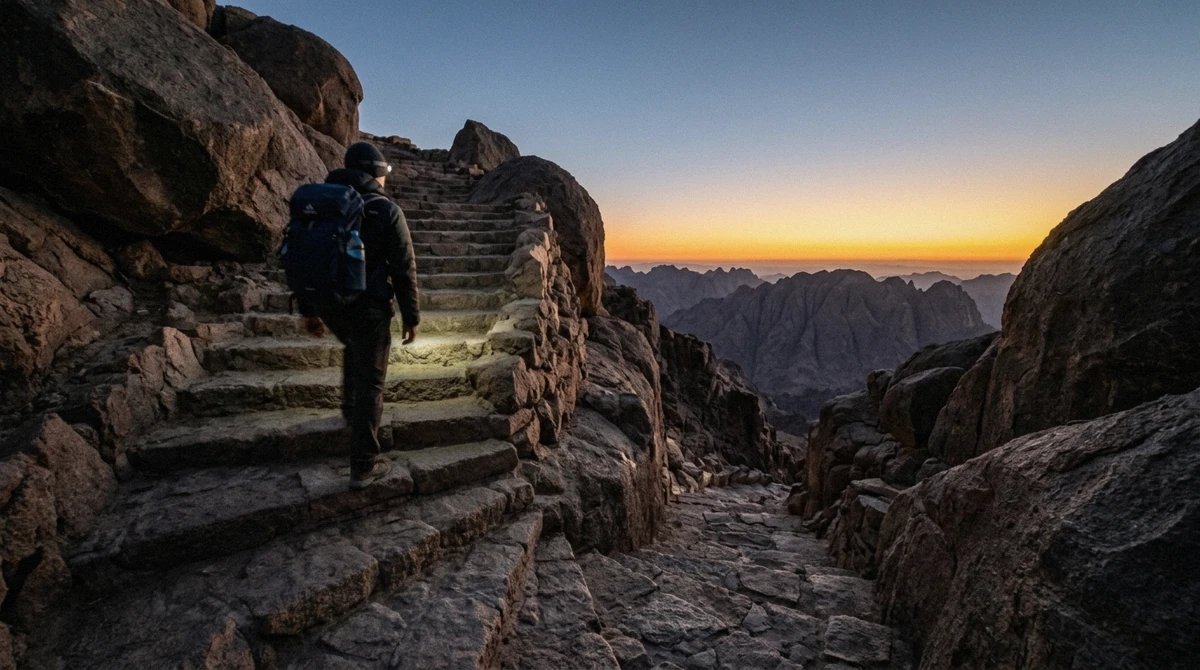
The climb starts on the camel path (Siket El Bashait), a winding trail about 4 km long that gains height gradually rather than steeply, covered in roughly 2 to 3 hours on foot. Tea huts appear every couple of kilometres, selling hot drinks and snacks for cash, and each one doubles as a natural rest stop. Camels are available for hire along this stretch, ridden as far as the foot of the final steps but no further, a genuine option for anyone who wants to shorten the walking part of the night.
A steeper alternative, the Steps of Repentance (3,750 stone steps), climbs more directly from the monastery, but almost every first-time climber takes the gentler camel path instead.
The 750 steps
At Elijah's Basin, where the camel path ends, the final 750 stone steps begin, steeper and slower than everything before them and typically taking 30 to 45 minutes. No camels continue past this point. This is the part of the night where the cold sets in fastest, since the steady effort of the camel path gives way to a slower climb with more standing around at each step.
The summit
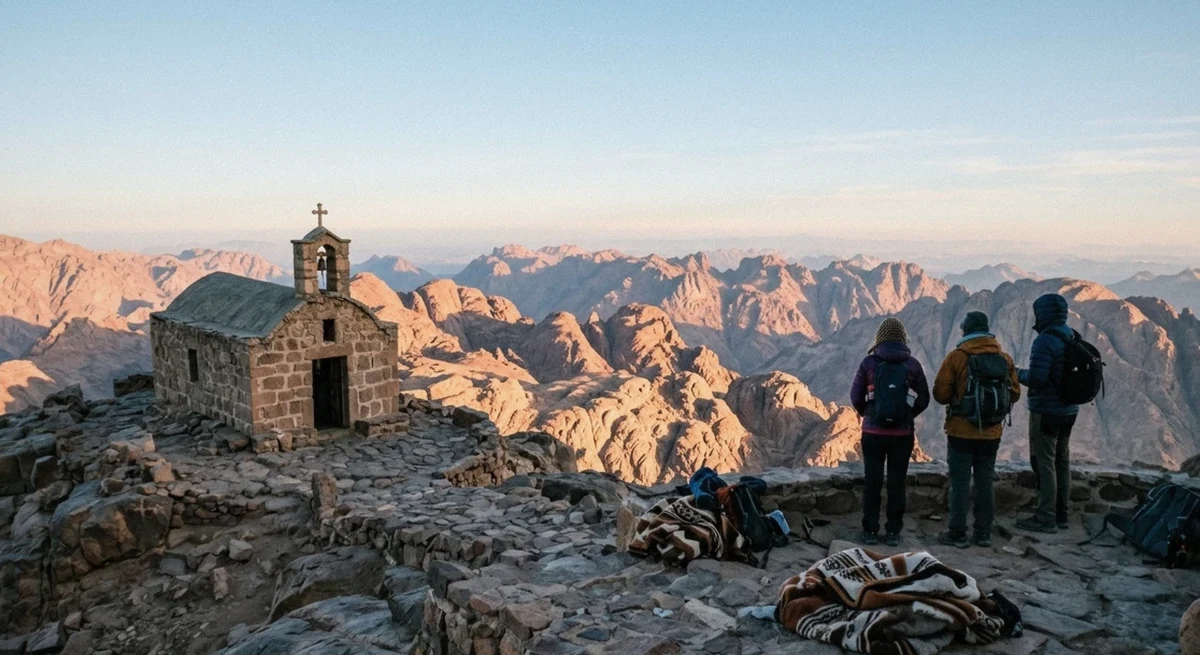
The summit holds a small Greek Orthodox chapel and a mosque, plus huts renting mattresses and blankets for the wait. Sunrise lands close to 5 am in summer and nearer 6:30 in winter, and the crowd at the top is at its thickest right at that moment, dozens of headtorches gathered around the same patch of rock. The view opens over the surrounding Sinai peaks as the light comes up, a landscape invisible during the dark climb.
The descent
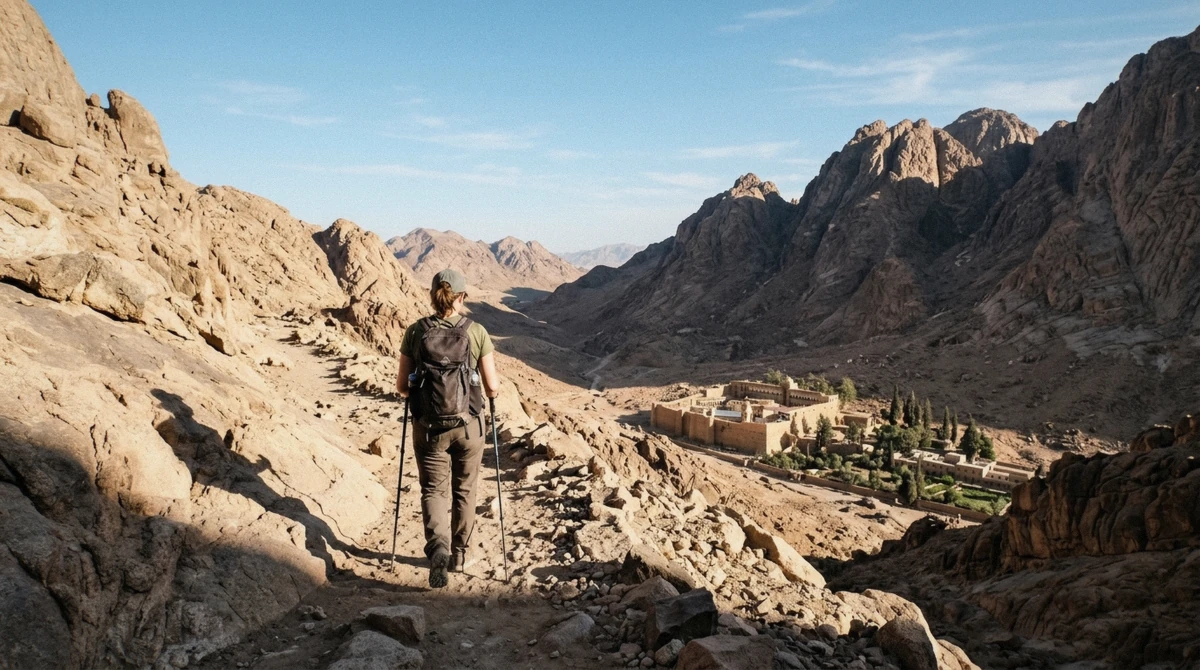
The descent retraces the same route and takes about two hours, and it's harder on the knees than the climb up was on the lungs; a walking pole helps more here than anywhere else on the route, and tired legs are the main reason to keep a slower pace than feels necessary.
Breakfast, the monastery and the bus
Most tours build in breakfast and a visit to the monastery itself once the descent is finished, timed inside its short opening window. From the monastery gate, it's about a 15-minute walk to the waiting bus for the ride back to Sharm, arriving early afternoon on most itineraries. Tipping the Bedouin guide is customary at the end of the night, on top of the fixed guide fee already built into the tour price.
The night in one table
The same walkthrough compresses into a single table, stage by stage, for a quick before-you-book reference. Distances and the two routes are set out on Wikipedia's Mount Sinai page; the operator figures come from the listings.
| Stage | How long | What happens |
|---|---|---|
| Booking and the day before | N/A | Passport copy requested, breakfast box arranged, an afternoon nap covers lost sleep |
| Pickup and the drive | 2.5 to 4 hours | 8 to 9 pm hotel pickup, about 230 km to Saint Catherine, checkpoints along the way |
| Registration and meeting the guide | 15 to 30 minutes | Tourism Police registration, then the Bedouin guide meets the group around 2 am |
| The camel path | 2 to 3 hours | About 4 km of gradual trail, tea huts every couple of kilometres, camels available for hire |
| The 750 steps | 30 to 45 minutes | Steeper stone steps from Elijah's Basin to the summit; no camels past this point |
| The summit | 1 to 1.5 hours | Waiting for sunrise, about 5 am in summer, 6:30 in winter, at the chapel and mosque |
| The descent | About two hours | Same route back down; hardest on the knees of the whole night |
| Breakfast and the bus | 1 to 2 hours | Monastery visit inside its short opening window, then a 15-minute walk to the bus |
What It Actually Feels Like
Dark, then cold, then bright, that's the shape of the night more than any single sensation. Once you stop moving at a tea hut, the cold sets in within minutes, even in July, so the huts are as much about staying warm as about resting. The trail itself runs quiet: mostly footsteps, occasional Bedouin chatter, the clink of a camel's harness passing in the dark.
Near the top, the crowd thickens and voices carry further in the cold air, dozens of headtorches bobbing up the final steps together. Then the light changes, slowly at first, then fast, and the mountain around you turns out to be one of hundreds of bare rock peaks stretching in every direction, a landscape entirely invisible on the climb up.
Nervous? What First-Timers Worry About
Most of the worry clears once the climb is underway, and naming it in advance usually does half the work.
The worries below are the ones reviewers of the tours compared here raise most often, set against what the listings and the route itself say happens.
| Worry | The reality | What helps |
|---|---|---|
| Fitness | A gentle, gradual trail for most of the distance, not a technical climb | Camels are available on the camel path if the pace feels too fast |
| The dark | Headtorches and a guide who knows the path make the night manageable | Stick close to the group; huts every couple of kilometres offer a reason to pause |
| Altitude | The summit sits at 2,285 metres, high enough to notice but not high enough for altitude sickness in most travellers | Slow down rather than push through breathlessness; the guide sets a pace for exactly this |
| Cold | The summit runs near freezing in winter and stays cool even in summer | Layer up and rent a blanket at the last hut before the final steps |
| The descent | Harder on the knees than the climb was on the lungs | A walking pole and a slower pace than the group around you both help |
| Needing a toilet | Basic or no facilities at the huts and the summit | Use a hut stop before or after resting, and expect very basic conditions rather than none at all |
| Being the slowest | Groups naturally spread out over the 4 km camel path | You can stop at any hut and wait, or take a camel to the foot of the steps |
| Camels | A handler leads each camel the whole way; nobody rides one alone | Walking the whole way instead is always an option, no camel required |
Beginner Mistakes to Avoid
A short list of avoidable errors, most of them logistics rather than fitness.
- Booking a Saturday-night climb: it lands you at the monastery gate on a Sunday morning, when it is closed
- Arriving without a headtorch: phone flashlights drain fast in the cold and leave both hands full
- Arriving in shorts: they're refused at the monastery gate regardless of how the climb went
- Wearing cotton only: soaked base layers cool fast once you stop moving at the summit
- Carrying no small Egyptian pound notes: tea huts, blanket rental and tips all run on cash
- Diving the day before: no climb is permitted within 24 hours of a scuba dive, a decompression-risk rule
- Attempting the Steps of Repentance on tired legs out of curiosity: 3,750 steps is a much harder route than the camel path most tours use
- Skipping the blanket at the last hut: the half-hour wait for sunrise is colder than the climb itself
Which Tours Are Best for First-Timers
Three listings suit a first climb for different reasons.
The private climb with a Jebeliya guide suits a nervous first-timer best: a private guide sets your own pace rather than a group's, children from age 5 can join, and the tour builds in the Tourism Police registration and a breakfast add-on at the top.
The $51 sunrise tour is the straightforward budget pick, printing two hours at the monastery and folding the protectorate fee and the Bedouin guide fee into the price, so there's nothing extra to negotiate at the gate.
The most-reviewed climb from Sharm runs briefings in three languages and prints its own closed-day calendar in the listing, useful for a first-timer trying to avoid a wasted trip on a feast day.
What to Wear and Bring (the Short Version)
The short version: a warm layer for the summit wait, a headtorch, closed-toe shoes with grip, cash in small notes, and long trousers or a scarf for the monastery visit afterward. Blankets rent for about 200 EGP at the last hut if the layers alone aren't enough. The full breakdown, including what each tour actually provides, is in what to wear for the Mount Sinai hike.
Which Climb Fits a First-Timer
If You want the most reassurance on your first climb
Book the private climb with a Jebeliya guide: a private pace, no group to keep up with.
If You're bringing a child on their first climb
The same private tour accepts children from age 5; other operators set the floor at 6 or 14.
If You want the simplest, cheapest first climb
The $51 sunrise tour folds the fee and the guide into one price and prints two hours at the monastery.
If English isn't your first language
The most-reviewed climb from Sharm runs briefings in three languages.
If You're nervous about the climb overall, not just the logistics
Read what actually happens step by step before you book; most worries fade once the sequence is familiar.
Before You Go: A Quick Checklist
A last check before pickup, condensed to the essentials already covered above.
- Tour confirmation saved offline, in case signal drops on the drive
- Passport, the physical copy, for checkpoints and the Tourism Police registration
- A warm layer for the summit wait, packed even in summer
- A charged headtorch, with spare batteries if you have them
- 1 to 2 litres of water for the walk up
- Egyptian pounds in small notes, for huts, blankets and the guide's tip
- Closed-toe shoes with real grip, already broken in
- Long trousers or a scarf, for the monastery visit afterward
First Climb: Frequently Asked Questions
How hard is the climb up Mount Sinai for a beginner?
Not technical: a long, gradual trail followed by 750 stone steps, manageable at an easy pace with rest stops built in every couple of kilometres. Reasonable fitness for a two-to-three-hour walk is enough; no hiking background is required.
How long does it take to hike Mount Sinai?
About 2 to 3 hours up the camel path and final steps, and about two hours back down, plus time at the summit waiting for sunrise. Most first-timers spend 4 to 5 hours total between the trailhead and the descent's end.
Are people allowed to climb Mount Sinai without a guide?
No. A licensed Bedouin guide from the Jebeliya tribe is mandatory by law, and registration with the Tourism Police happens before every climb starts.
Can children climb Mount Sinai?
Yes, with age limits set by the operator rather than by the mountain itself: from age 5 on the private guided climb up to a rule against anyone under 14 on other tours.
What happens if I cannot finish the climb?
You can stop at any tea hut and wait, or take a camel to the foot of the final 750 steps. Groups naturally spread out over the 4 km camel path, so falling behind the front of the group is normal, not a problem.
Is there a toilet on Mount Sinai?
Expect very basic or no facilities at the huts and the summit, and plan accordingly rather than counting on one being available at a specific point.
The mechanics of the night are the whole difficulty of a first Mount Sinai climb: the guide, the registration and the pace are all handled by the operator you book. For the safety rules and who should think twice before climbing, the homepage covers that ground directly. Once the walkthrough above feels familiar, the comparison of Mount Sinai climbs lines up the private, budget and most-reviewed options side by side.